Background
A Central Queensland coal mine encountered significant corrosion issues in its clarified water systems. Initial bench trials revealed a corrosion rate of 9.86 MPY (milli-inches per year) on mild steel, which is considered high and unacceptable by industry standards.
These corrosion levels can lead to increased maintenance costs, reduced equipment lifespan, and potential operational disruptions.
WTS solution
Water Treatment Services (WTS) was engaged to evaluate and implement a corrosion control strategy. The primary goal was to assess the effectiveness of WTS 5-0017, a proprietary corrosion inhibitor, in reducing corrosion rates in clarified water.
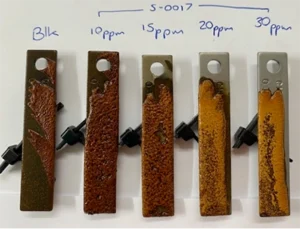
Bench trials were conducted using certified carbon steel (C1010) coupons suspended in both treated and untreated clarified site water over a seven-day period.
WTS key solutions
- Defined the corrosion problem and selected
WTS 5-0017 as the optimal chemistry - Conducted bench trials at varying dosages (10, 15, 20, and 30 ppm)
- Measured corrosion rates by calculating the weight loss of steel coupons
- Analysed trial data to determine the most effective dosage, with 30 ppm yielding the best results.
- Ongoing optimisation based on seasonal changes and system performance.
 |
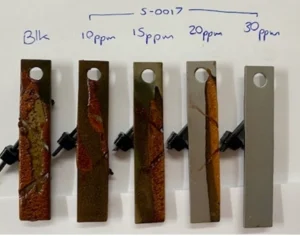 |
| Front of coupons WTS 5-0017 dosing |
Back of coupons WTS 5-0017 dosing |
Results and Benefits
- Corrosion reduction: Achieved a 56% reduction in corrosion rate, lowering it from 9.86 MPY (high, unacceptable) to 4.34 MPY (moderate, acceptable) with WTS 5-0017 treatment.
- Asset protection: Improved protection of plant infrastructure and equipment will reduce the risk of premature failure due to corrosion.
- Operational reliability: Enhanced system reliability and reduced the likelihood of unplanned maintenance or downtime.
- Cost savings: Lower maintenance and replacement costs by extending the lifespan of critical assets.